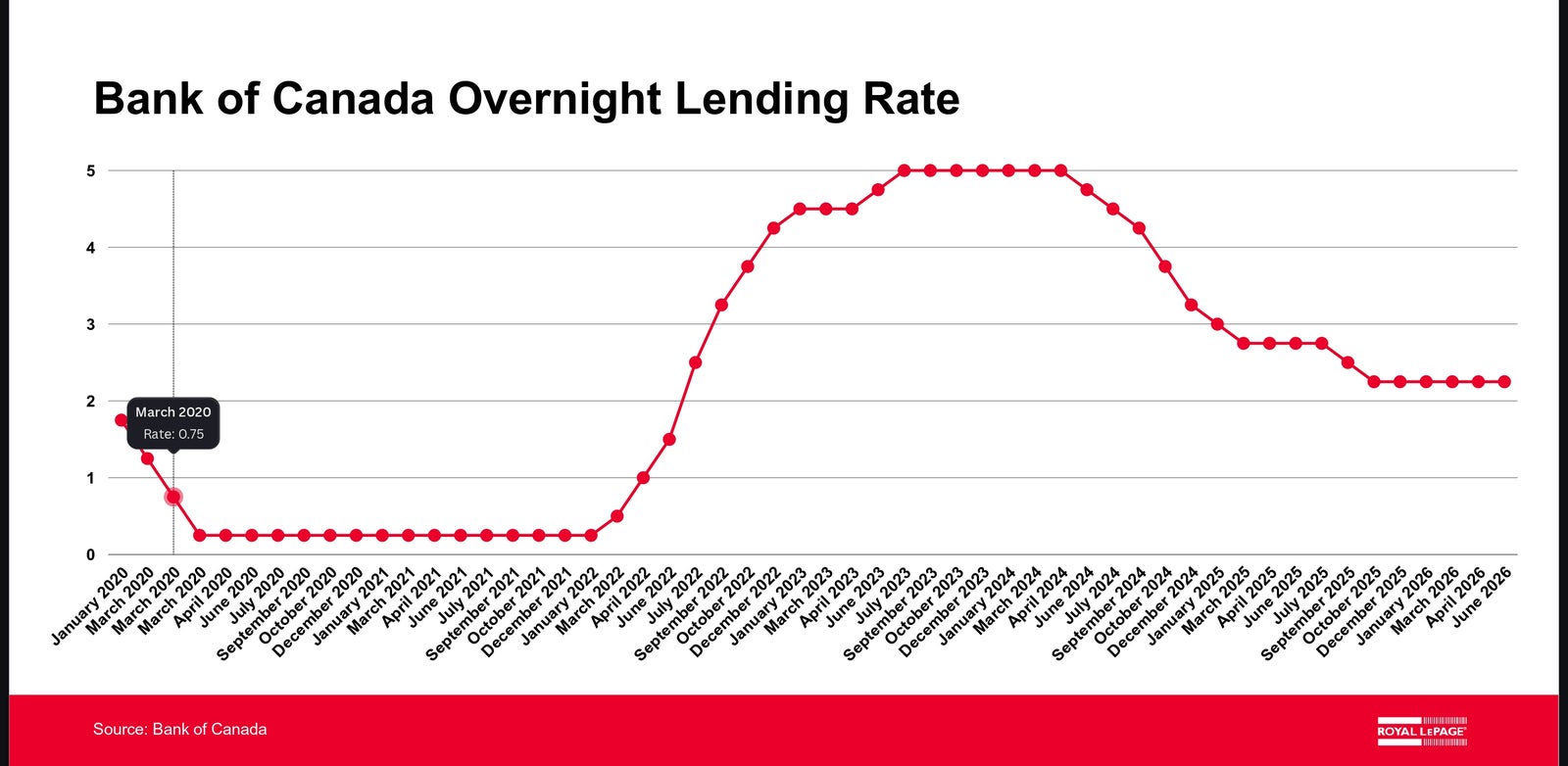
In its fourth scheduled announcement of 2026, the Bank of Canada held the target for the overnight lending rate at 2.25%. This marks the fifth consecutive hold to interest rates since October of last year.As the conflict in the Middle East continues, elevated energy prices and ongoing supply chain pressures are contributing to higher inflation, even as Canada’s economy remains soft. While employment levels have remained relatively stable, economic growth has weakened and uncertainty surrounding United States trade policy persists, factors that influenced the Bank’s decision to keep the key lending rate at its current level this month. “Since our April decision, the economic impact of the ongoing conflict in the Middle East has increased. Higher energy prices and disruptions in global supply chains are weighing on global growth and pushing up inflation. At the same time, the US administration continues to propose new tariffs and trade policy uncertainty remains elevated,” said Tiff Macklem, Governor of the Bank of Canada, in a press conference with reporters following the announcement. “Against this backdrop, the Canadian economy has remained soft and inflation has increased. Monetary policy continues to be focused on ensuring higher energy prices do not turn into persistent inflation, while helping the economy adjust to headwinds. We are committed to keeping inflation low and stable over time.“Economic weakness combined with rising inflation is a dilemma for monetary policy. Raising rates to dampen inflation could further slow the economy. Easing rates to support growth increases the risk that higher inflation becomes persistent. For now, holding the policy rate unchanged balances those risks.”Canada’s economy is caught between competing pressures. Statistics Canada reported that GDP contracted 0.1% on an annualized basis in Q1 2026, confirming a technical recession. At the same time, inflation has edged higher; the Consumer Price Index (CPI) rose 2.8% year over year in April, up from 2.4% in March, driven largely by higher gasoline prices. That increase reflects both ongoing geopolitical tensions and a base effect from April 2025, when the removal of the federal consumer carbon levy had temporarily suppressed fuel costs. Meanwhile, the labour market has shown some resilience, with the unemployment rate dipping to 6.6% in May.